A timely reminder to make room for the speaker
On October 15, Fusemachines announced HireFoundry.ai, a platform bringing together agents for tasks including candidate shortlisting and interview assistance. It is one company’s announcement, rather than evidence of adoption across hiring. But it raises a useful question for anyone preparing with AI: what should the technology help you improve? Read the announcement.
The same week brought a different reminder. 50 Million Voices scheduled its Global Practice Interview Event for October 12–19, supporting people who stutter and the people who interview them. The event dates overlap the past week; this is an ongoing practice programme, not a new AI study. See the organiser’s programme.
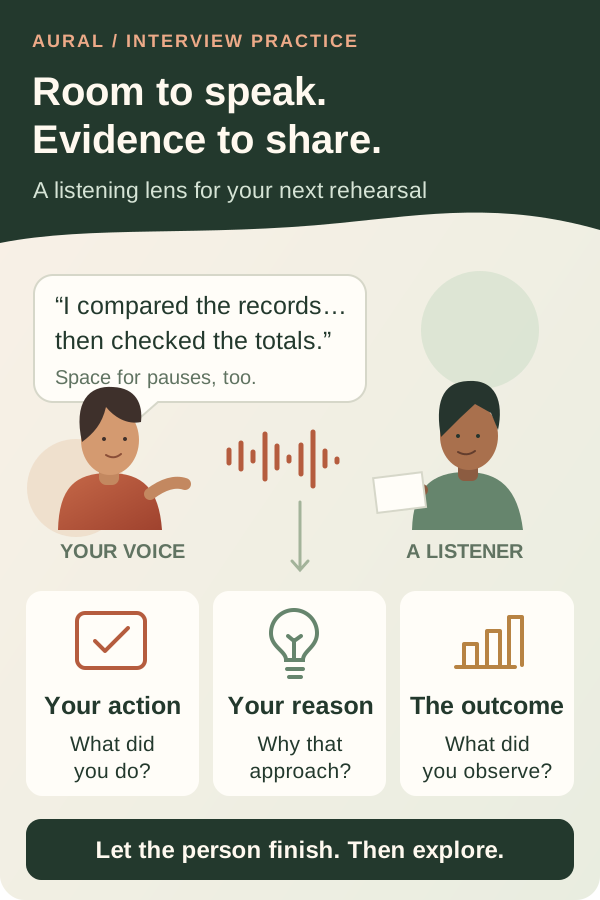
Our recommendation is to make the goal of practice explicit: help your experience and ideas come through. AI can help you notice missing evidence, rehearse a question, and review a transcript. A fluent-sounding answer still needs substance, and a pause does not tell a listener whether the speaker knows the answer.
Decide what you want the next attempt to show
Before recording, choose one question and one useful goal. For “Tell me about a difficult project,” a goal might be to explain a decision you owned and how you checked it. For a stakeholder question, it might be to make the disagreement and your response easier to follow.
Write three notes outside the practice session: the situation, your contribution, and the evidence you can honestly describe. Keep the wording loose enough to explain naturally. If you do not have a measured result, describe what you observed and what you still do not know.
Someone who stammers may also want a human practice partner or a conversation about the interview format. STAMMA’s interview guide discusses preparation and options such as additional time, notes, and written responses. Discuss what would help with the recruiter; a rehearsal tool cannot arrange those changes with an employer.
Give Aural the context for useful feedback
Aural Practices uses the questions in an existing interview. Open its Practices tab and add relevant context: the role title, company, job description, and concise resume notes. Choose details that help explain the role and your experience, without adding confidential employer or customer information.
Then start a practice interview and answer a question. In focused voice practice, your response appears in a composer for review before you submit it. Submitted attempts receive coaching feedback, and you can retry the question. These practice runs are saved separately from real candidate sessions.
The context guide explains the setup, and the practice-session guide walks through answering and reviewing feedback. Start with a question you know well so you can check whether the tool captured your meaning.
Check what was heard before judging what was said
Read the transcript before submitting your answer. Check names, technical terms, numbers, negations, and any sentence that feels incomplete. “We did not launch” and “we did launch” describe different decisions. If recognition changed your meaning, correct the composer text before asking for feedback.
Keep that correction separate from rewriting the answer. First restore what you actually said. Then use the feedback to decide what to change on the next attempt. Otherwise, you may end up evaluating an edited response you never rehearsed aloud.
Aural also provides automated voice-delivery feedback. Some delivery indicators are estimated from audio volume, pauses, and transcript timing; one “confidence” indicator uses volume and variation. Treat those labels as limited coaching signals. They do not establish how confident you felt, your knowledge, or how you would perform at work.
Do not use these metrics as a stammering-specific assessment. If recognition repeatedly loses your meaning or delivery advice is unhelpful for you, use a human practice partner to review the answer. The useful question is whether your example demonstrates the skill you intended to show.
Make one revision you can explain
Read the strengths, improvements, and missing signals in the feedback, then choose one content change. You might name your personal responsibility, explain a trade-off, or add the check you performed. You do not need to accept every suggestion to make the next attempt worthwhile.
Consider a fictional answer: “There was a reporting problem, and I helped the team fix it.” The missing information is what the person did. A useful revision could be: “I compared the dashboard with the source records and found that cancelled orders were being counted. I worked with the analyst to change the filter, then checked the revised totals against a manual sample.”
The revision gives a listener something concrete to discuss. It does not need an invented percentage improvement or a memorised opening. For your own answer, use only actions you took and outcomes you can support. If the work was shared, say which part was yours.
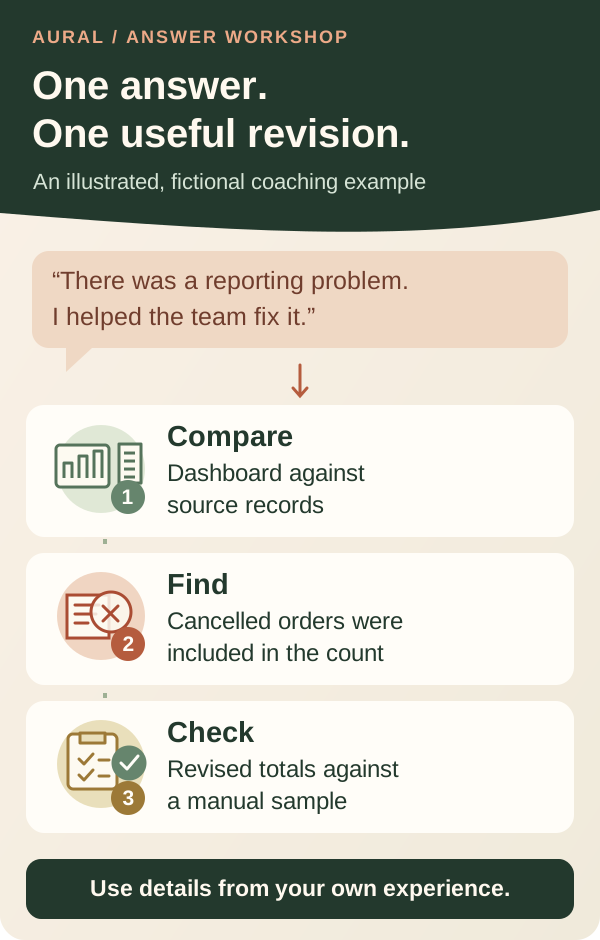
Record another attempt in your own words. Afterwards, ask whether the intended detail came through and whether the account remains accurate. Aural’s suggested answers can help you study a structure, but check every claim against your experience before reusing it.
Keep a human listener in the loop
Use a trusted person for an occasional rehearsal too. Ask them to describe what they understood about your decision and contribution, then compare that with the AI feedback. A difference between the two is a useful point to discuss, rather than a reason to assume either reading is complete.
For interviewers, STAMMA’s inclusive interview tips recommend giving people space without finishing their sentences and allowing flexibility in how they respond. Apply that attention to the person when reviewing practice answers as well.
To try the workflow, open an interview you control in Aural Practices. Rehearse one question, check the transcript, and choose one change that makes your experience easier to understand. Keep the version that is accurate and useful to you.