The next AI interview question is about judgment
“Which AI tools do you use?” is a useful opener. It is a weak assessment on its own. A candidate can name the latest assistant without explaining when its output should be challenged, checked or discarded.
Two reports released last week make that distinction timely. In a September 21 study announcement, IBM reported that 71% of surveyed CHROs identified supervising, validating and overriding AI outputs as the workforce’s most essential skill. The study included 1,500 CHROs and 8,800 employees globally. These are survey findings about workforce priorities, not evidence that any particular interview method predicts performance. Read IBM’s announcement.
On September 22, SHRM published an analysis of AI skills in IT and computer science job postings across 27 countries. It found rising demand across the countries studied, with substantial differences by market and occupation. Its scope matters: this is evidence from technical job postings, not every job or industry. Read SHRM’s findings and methodology.
For hiring teams, our practical interpretation is simple: define the AI decisions a role actually involves, then ask candidates to explain those decisions. Do not turn every interview into a quiz about model names.
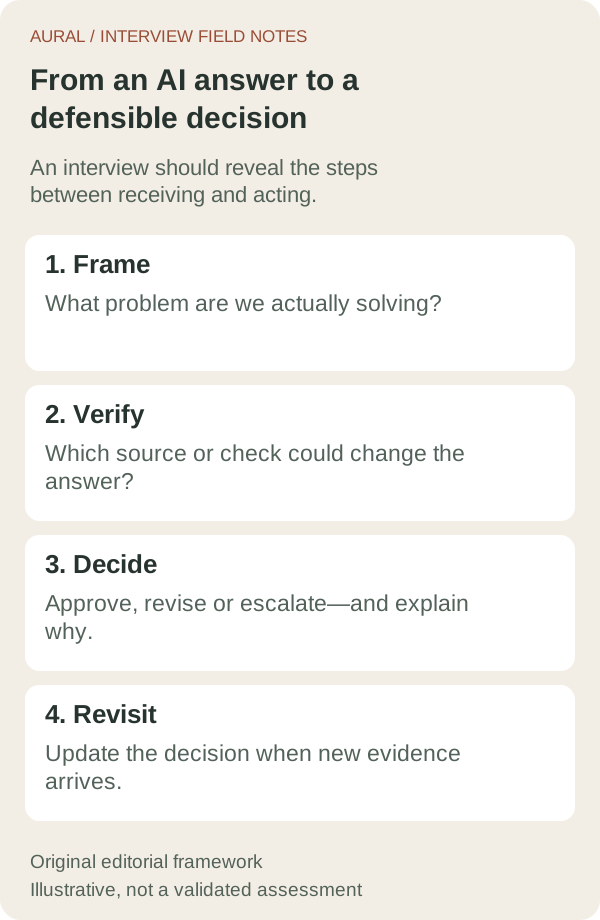
Make the task look like the work
Start with one ordinary decision. For a customer operations role, that might be reviewing an AI-written response to a refund request. For an analyst, it could be checking a summary against the underlying spreadsheet. For a software engineer, it might be evaluating an AI-generated patch and its tests.
Give every candidate the same source material, instructions and time allowance. State whether AI tools are permitted and what access is provided. If the task requires a paid tool, provide equivalent access rather than measuring who already has a subscription.
The exercise below is an original example, not a customer case study or a validated assessment. Adapt it to the responsibilities of the role before using it.
A short exercise: approve, revise or escalate?
Imagine a customer operations candidate receives this fictional policy: “Refunds are available within 30 days. Requests involving duplicate charges must be reviewed by the billing team.” The customer says they were charged twice 45 days ago. An AI assistant proposes: “You are outside the refund window, so we cannot help.”
Ask: Would you send this response? Explain your decision and the next step.
A useful answer should recognize that the duplicate-charge exception needs review. It should distinguish what the policy establishes from what still needs checking. It should not invent a refund approval, promise a resolution time absent from the policy, or dismiss the customer solely because 30 days have passed.
Then choose a follow-up tied to the reasoning: “What information would you verify before escalating?” or “How would your answer change if billing confirmed there was only one charge?” The aim is to see whether the candidate can update a decision when the evidence changes.
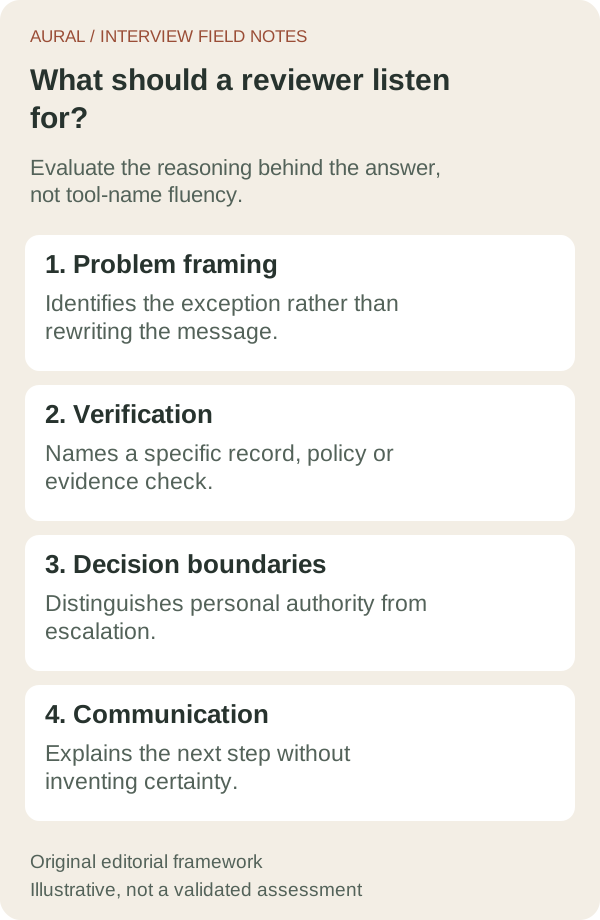
Look for evidence in four places
Problem framing. Does the candidate identify the real issue and the relevant exception, rather than simply rewriting the AI response?
Verification. Can they name the source or check needed to resolve uncertainty? “I would double-check” is less informative than identifying the transaction record and the duplicate-charge policy.
Decision boundaries. Do they know what they can decide themselves, what requires escalation, and what they should avoid promising?
Communication. Can they explain the next step clearly without pretending the issue is already resolved?
Use these as discussion anchors, not an automatic pass/fail formula. Before an interview round, have reviewers assess a few sample answers together and discuss disagreements. Keep the expectations tied to the role’s actual responsibilities. A confident speaking style should not substitute for sound reasoning.
How to run the conversation in Aural
Aural can support the interview structure around this exercise. Create an interview with the fictional policy and customer scenario in the question context, then add an open-ended question asking for a decision and explanation. Review the wording yourself before sharing the interview.
Configure follow-up depth to suit the exercise. Aural supports different follow-up settings, so a short screening conversation does not need the same depth as a more detailed discussion. Use the same core scenario and configuration across the round, while recognizing that adaptive follow-ups can still differ between candidates.
Afterward, use the session transcript and per-question evaluation to locate the evidence behind a response. Treat AI-generated scores and summaries as review aids. The four dimensions above are a proposed reviewer framework; they are not a claim that Aural automatically implements a validated AI-judgment scorecard.
For candidates who want to rehearse, Aural Practices provides a separate coaching workflow. Use a different practice scenario so the real exercise still reveals how the candidate reasons through unfamiliar information.
Explore Aural Practices, or read our guide to the Aural interview API if you need to connect interview workflows to your own system.
Start with one role, one scenario and one review
An AI tool list tells you what a candidate has encountered. A concrete decision, followed by a carefully chosen question, gives you evidence of how they work.
For your next interview round, pick one role-relevant AI failure, write a short source pack and agree on the evidence reviewers should look for. Pilot it with colleagues before using it with candidates. Check whether the instructions are understandable and whether different reviewers reach similar conclusions for the same reasons.
If you already use Aural, try building that scenario into a short structured interview. The goal is a clearer conversation about judgment—not another AI badge on a résumé.