The work continues after the draft is finished
On October 27, Atlassian published an account of an internal workshop about AI workslop: polished output that leaves the recipient to do the difficult work. Its pilot involved 31 employees from five teams, with workshops held in June. Participants discussed quality standards and practised creating pages with AI. Atlassian explicitly notes that the pilot’s quality results were not statistically significant. It is a useful workplace example, rather than proof that one workshop will improve every team. Read Atlassian’s account.
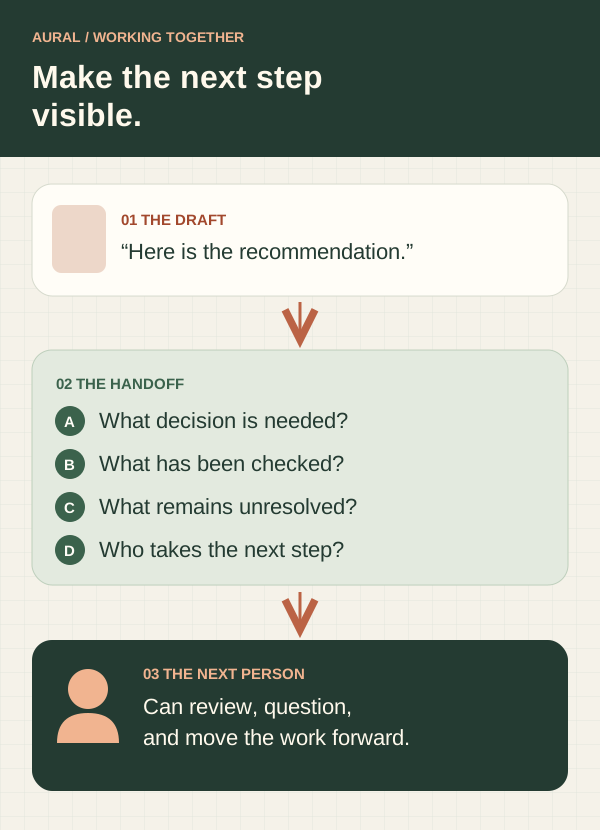
For a hiring team, that suggests a practical interview topic: what happens when someone hands their work to a colleague? A document can be readable while leaving its purpose, unresolved questions, and next action unclear. Ask candidates how they handle that transition in work relevant to the role.
The interview below focuses on collaboration at the handoff. It is a proposed question set and review guide, not a validated assessment or a test of which AI brand someone uses.
Choose one handoff that belongs to the job
Start with the person who receives the work. For a product role, that could be an engineer reviewing a specification. For customer operations, it could be a teammate taking over an unresolved case. For an analyst, it could be a manager deciding what to do with a recommendation.
Write down what that recipient needs to continue: a decision, relevant context, checks already completed, unresolved issues, and a named next step. Pick the items that genuinely matter for the role. A short operational note and a technical design document do not need identical review processes.
Tell candidates the scope and expected format in advance. Ask them to describe a real example without sharing confidential material. If they have not used AI in that workflow, accept a comparable example and discuss the AI-assisted scenario separately.
Ask about the handoff, the repair, and the deadline
Use a small set of questions that follows the work from preparation to feedback. These examples are written for a role where colleagues regularly review written deliverables:
- The handoff: “Tell me about a deliverable you passed to someone else. What did they need to do next, and what did you include to help them?” Listen for the recipient’s task and the candidate’s own contribution.
- The repair: “Describe a time a colleague could not use your first version. What was missing, and what did you change?” Look for a concrete response to feedback, rather than a claim that misunderstandings never happen.
- The deadline: “An AI-assisted draft is due today, but one important claim remains unchecked. How would you handle the handoff?” Let the candidate explain what they would verify, defer, label, or discuss with the recipient.
A useful probe is “What did the recipient do with that information?” It asks for the effect of the handoff without assuming the work succeeded. When someone describes a team outcome, ask which part they personally handled. Keep a hypothetical response distinct from evidence of something they have actually done.
Agree on what evidence you will review
The U.S. Office of Personnel Management describes structured interviews as using predetermined questions and common rating standards. Use that principle to agree on job-relevant criteria before reviewing candidates. See OPM’s structured-interview guidance.
For this interview, a team could review four dimensions: understanding the recipient’s task, explaining checks, making uncertainty visible, and taking responsibility for the next step. Write examples of what each looks like in the actual job. “Good communicator” is too broad to tell reviewers what to look for.
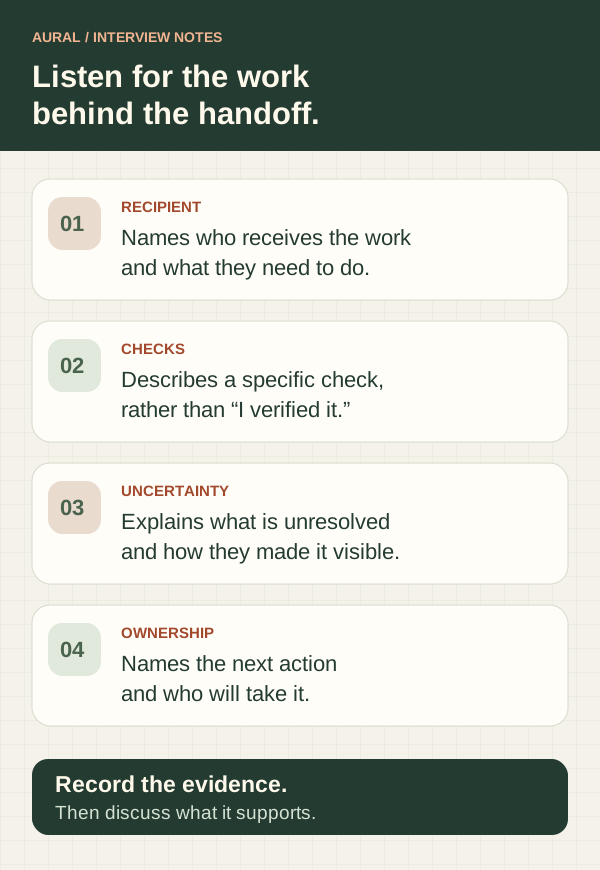
For example, “I verified the figures” leaves the method unclear. “I compared the totals with the source file, marked the missing region, and asked the reviewer whether to delay the decision” gives a reviewer specific actions to examine. That example is invented; it illustrates detail, not a required script or a universally correct response.
Record missing evidence as missing evidence. Do not infer that a candidate lacks a skill because a question failed to elicit it. Rehearse the questions with colleagues and check whether reviewers interpret the criteria consistently before using them in hiring.
Build and rehearse the conversation in Aural
In Aural, add these as Open-Ended questions, which support free-form voice or text answers. Review the question wording and assessment criteria for the role. The question-type guide explains the formats and how to reuse questions through the library.
Check the interview’s language and follow-up depth in interview settings. Keep the same core questions and a consistent approach to probing across candidates. Adaptive follow-ups can produce different conversations; they do not by themselves make an interview fully standardized.
Use Practices to rehearse the existing interview questions before inviting candidates. After a candidate session, the session report provides a transcript, summary, and question-level evaluations. Check the relevant passages against your criteria; an AI evaluation is an input to human review, not evidence of future job performance.
Make the next person part of the question
A candidate’s account of a handoff can reveal how they think about colleagues, incomplete work, and responsibility. It still needs careful review alongside the rest of your assessment. An interview account is different from observing someone perform the task.
For your next interview, choose one real handoff from the role, write three questions, and agree on the evidence reviewers should record. Then rehearse the conversation in Aural. The goal is a clearer account of how the candidate helps someone else continue the work.