A good follow-up earns its place
You ask someone why they turned off an account alert. They say, “It kept going off at the wrong time.” The next question could ask when it happened, or it could jump straight to whether the product needs a snooze button. Only one of those questions helps you understand the incident before proposing a fix.
Two research preprints revised on November 2 put this trade-off in focus. The SparkMe paper treats covering the guide, following new leads, and keeping the conversation short as competing goals. A separate market research study reports that more detailed interviews did not necessarily make simulated consumers better at predicting what real participants would say. Both papers evaluate their own study setups; neither tests Aural.
The practical takeaway is to rehearse the interview itself. Listen for what a follow-up helps you learn, what it costs in time, and whether the conversation still reaches the questions you need answered.
Decide what the conversation must cover
Imagine you are trying to decide whether to change the timing of an account alert. For a first guide, you might need to hear about the last time it appeared, what the participant was doing, and what they did next. Write those as separate, plain questions. Save ideas about changing the product for a later conversation.
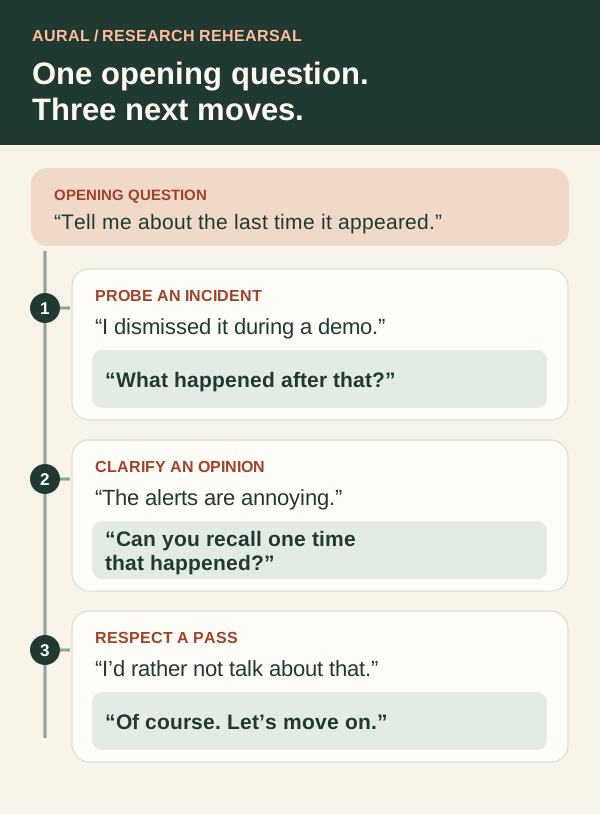
Open with “Tell me about the last time this alert appeared.” Leave room for people who have never seen it, or who do not remember. If they describe a real incident, ask what they did next. If they cannot recall one, ask how they usually notice a change in the account. Record that answer as a description of their usual routine, rather than an incident.
Give the guide three different answers
Use the same opening prompts and the channel participants will use. Have a teammate answer each run differently, with invented details. The aim is to see where the interview gets stuck, not to predict how customers will answer.
- A specific incident: “The alert appeared while I was sharing my screen, so I dismissed it.” A useful probe asks what happened after dismissal. Notice whether the interview repeats a detail the participant already gave or assumes they wanted to turn all alerts off.
- A broad opinion: “The alerts are annoying.” Look for one neutral invitation to describe a specific instance. If no example comes to mind, see whether the conversation can proceed without treating an opinion as a reported event.
- A pass: “I’d rather not talk about that.” Look for a brief acknowledgment and a transition. Repeating the question or reframing it to extract the same information creates pressure and uses time you could spend elsewhere.
In Aural, use the Research question type for exploratory questions. Check your language, channel, and follow-up depth in interview settings, and use the interview preview for rehearsal. The question guide explains how Research differs from Open-Ended. Judge the conversation you observe rather than assuming a depth setting will produce the same probes every time.
Write down where the run went off course
After each run, note whether it reached the planned topics, whether each probe responded to something the participant said, and whether it wrapped up within your planned session length. A probe can be relevant and still spend too long on a low-priority detail. A short session can also skip the one question you needed.
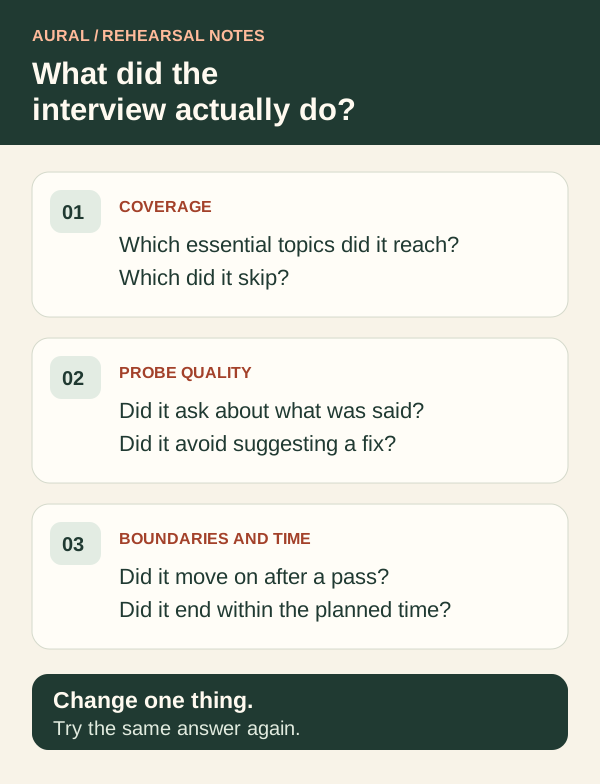
Be concrete about what you observed. “The interviewer followed up twice” tells you little. “It asked for a timestamp twice after the participant said they couldn’t remember, then skipped what they did next” gives you something to fix. If an early question consistently crowds out a later one, try narrowing the opening prompt or moving the essential question earlier.
Change one thing and run the same case again
Suppose the guide asks when the alert appeared and how the participant felt in one question. Split it. Ask what was happening when it appeared, then ask what the participant did next. Rerun the same broad-answer case to see whether the revised prompt makes it easier to move from an opinion to an example.
If you change follow-up depth, compare the same input before and after. Check what you gain as well as what you lose: an extra probe may recover a useful detail, or it may leave less time for the last topic. Use the same rehearsal notes so that “better” has an observable meaning.
Take one rehearsed guide into a small pilot
Once the guide handles the three cases, try it with a small group of real participants. Tell them how the conversation works and how you will use their responses. Rehearsal can expose avoidable problems; it cannot establish how real participants will interpret the questions or how common a concern is.
Start with one Aural research interview and one decision you need to make. After the pilot, use the guide to checking research evidence to separate what participants said from what you infer. A useful pilot gives you a better guide and a clearer question for the next round.